The Wireless and Mobile Communications Lab (WMCLab) announces the publication of the research paper" RF-EMF exposure in the transition to 5G: A multi-dimensional measurement campaign in the Peloponnese Region of Greece" in the journal Environmental Monitoring and Assessment. The study was authored by Dimitra Zarbouti, Georgia Athanasiadou, George Tsoulos, Thanasis Christopoulos, Vassilis Tsoulos, Nikolaos Chaloulakos, George Nikitopoulos, Nikolaos Christopoulos, Panagiotis Papadopoulos, and Athanasios Papakondylis.
The study provides a comprehensive regional assessment of radiofrequency electromagnetic field (RF-EMF) levels during the early deployment phase of 5G technology in Greece. This work addresses the need for recurrent, large-scale measurement campaigns to track network development as cellular landscapes transition from legacy systems toward next-generation architectures. The work aligns with the core research expertise of WMCLab in 5G–6G technologies, wireless system measurements, and EMF exposure assessment.
Methodological Approach
The research utilized a dual spatial-temporal methodology to capture a holistic footprint of the electromagnetic environment in urban and suburban settings. The campaign, conducted between July 2023 and June 2024, employed two distinct frequency-selective measurement systems:
- Spatial Analysis: Short-term ground-level measurements were performed at 77 sites across seven major cities in the Peloponnese Region. These measurements utilized an isotropic triaxial antenna to ensure accurate assessment in non-homogeneous environments.
- Temporal Analysis: Long-term continuous monitoring was conducted over 32 weeks in Kalamata at fixed urban locations to identify daily peak exposure patterns.
- Multi-dimensional Decomposition: Leveraging the frequency selectivity of the equipment, the study distinguished contributions by service type, cellular generation (2G, 3G, 4G, and 5G), and specific network operators.
- Rigorous Uncertainty Assessment: Following the IEC 62232 standard for high-quality exposure assessment.
Key Findings
The study confirms that RF-EMF exposure levels in the region remain significantly below the stringent safety limits established by Greek legislation and international guidelines. The evidence indicates that 4G technology remains the primary contributor to cellular EM emissions, accounting for 53% of the impact, while 5G currently contributes approximately 3%, reflecting its early stage of rollout in the region. Temporal data revealed that peak exposure coincides with periods of increased network usage, typically between 15:00 and 21:00. These findings provide baseline data for future longitudinal studies as 5G infrastructure continues to expand and mature.
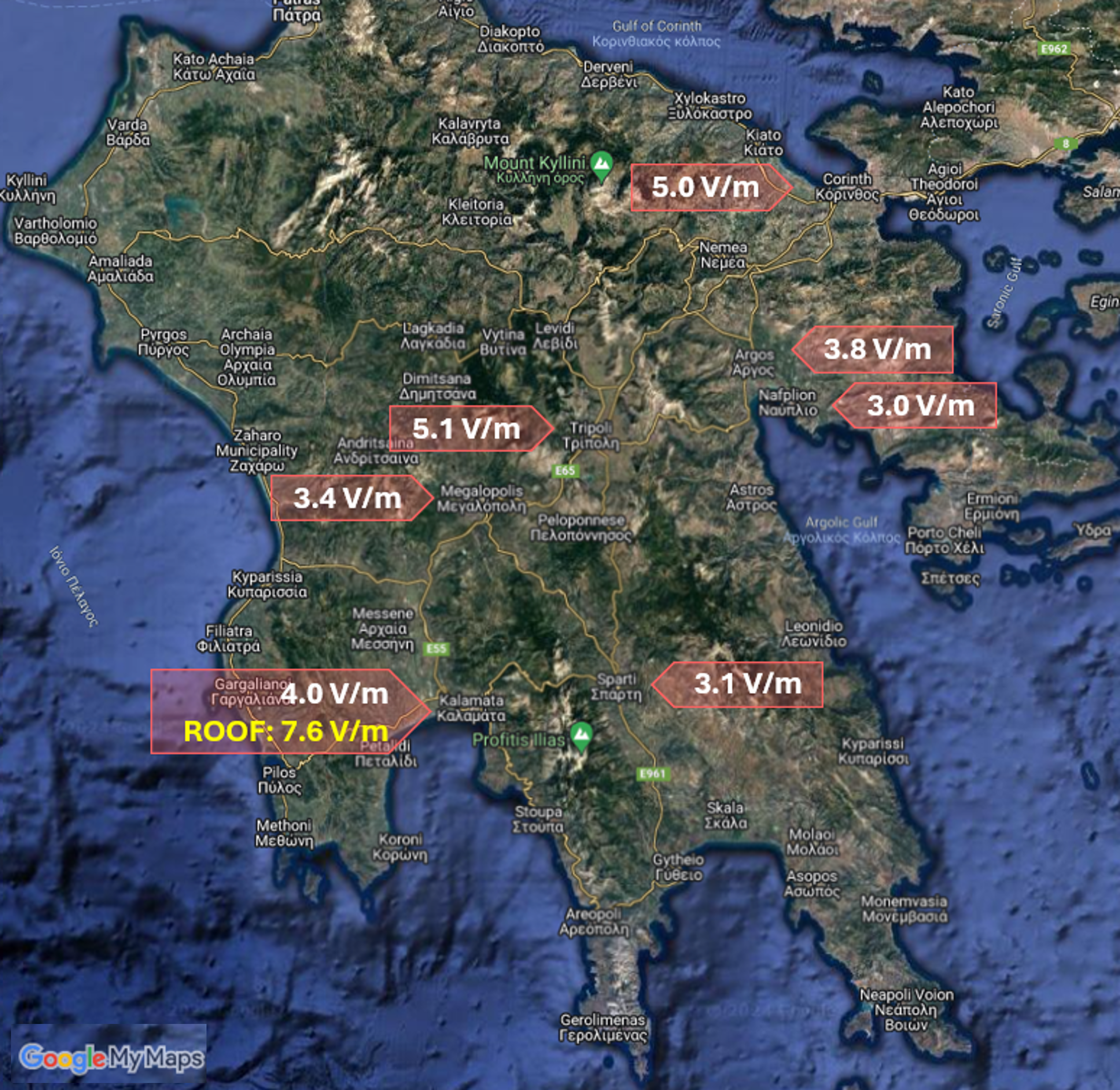
Maximum Wideband E-field Measurements per City across the Peloponnese Region.
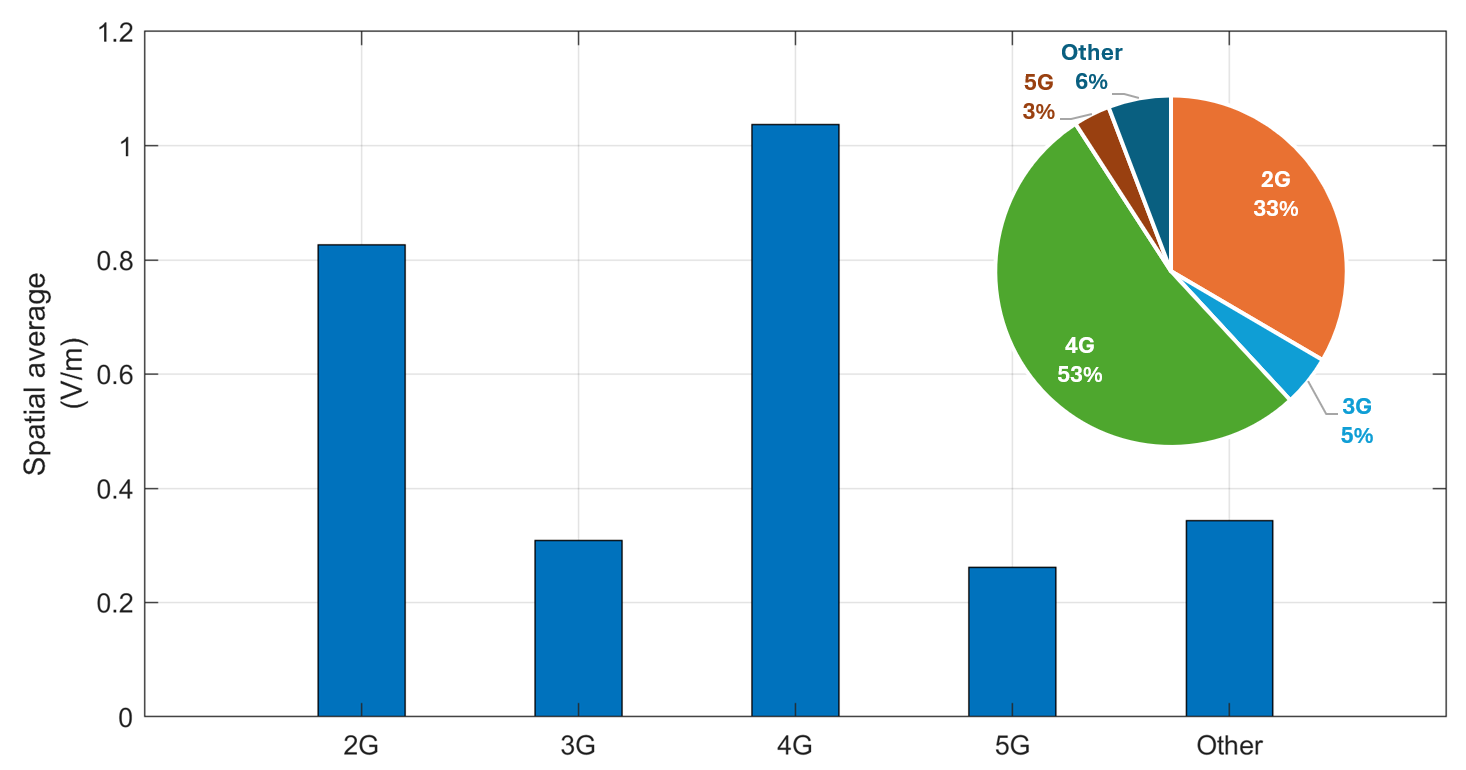
Contribution of each Cellular System to the EMF Exposure (4G at 53%, 5G at 3%).
Funding
This research was conducted as part of the PANDORA project, funded by the NSRF 2021-2027 program (MIS 6001405).
🔗 Related links:
- Publisher Page (Springer): https://link.springer.com/article/10.1007/s10661-025-14876-9
- Open-Access Full Text (View-only): https://rdcu.be/eTTlg
- PANDORA Project Website: https://wmclab.uop.gr/pandora.php