Following the establishment of the INTERPLAY experimental infrastructure, the project has advanced its research foundations across four complementary directions: interoperable IoT sensing and actuation, 5G link reliability, AI-based signal forecasting, and site-specific urban propagation analysis.
Research highlight: Building an interoperable IoT foundation
A core requirement for resilient smart-city infrastructures is the ability to integrate heterogeneous sensing and actuation systems into a common operational framework.
The INTERPLAY team has addressed this challenge by developing and validating a multi-protocol IoT architecture designed for reliability and scale.
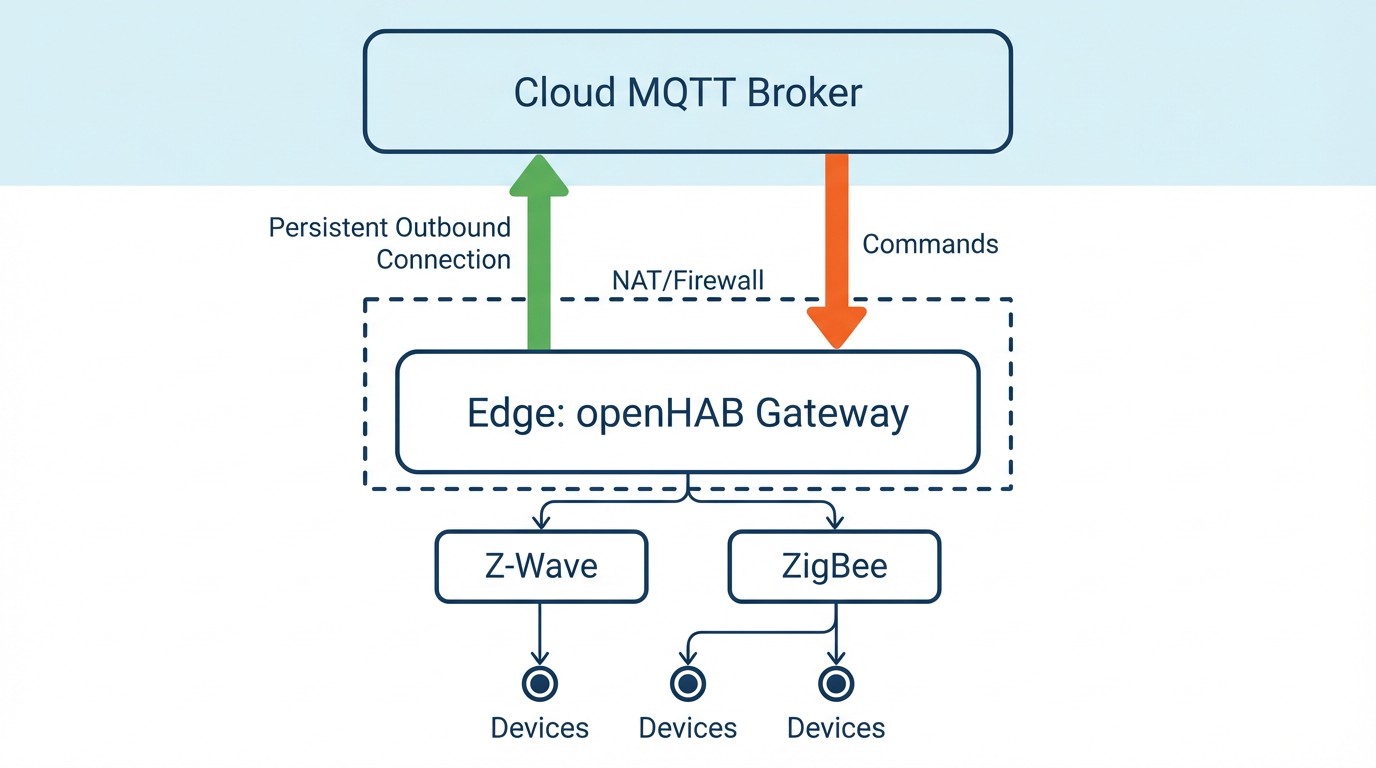 Open IoT architecture for integrating heterogeneous sensing and actuation devices
through
a secure MQTT-based communication layer.
Open IoT architecture for integrating heterogeneous sensing and actuation devices
through
a secure MQTT-based communication layer.
The architecture: from data flows to coordinated response
Moving beyond isolated devices, this open-source reference implementation creates a seamless flow of information:
- Integration: unites Z-Wave and ZigBee devices through openHAB middleware.
- Communication: leverages a secure MQTT layer for bidirectional communication.
- Analysis: utilizes InfluxDB for time-series storage and Apache Parquet for analytics-ready data exports.
Proven performance
The system was validated over a multi-month deployment across two university laboratory sites, demonstrating reliable environmental sensing and bidirectional control.
The results show:
- temperature data completeness above 98%,
- a bidirectional MQTT control plane with 287 ms median command latency,
- near-perfect reliability with 99.92% command success rate, and
- HVAC control validation with an 18-minute median setpoint response time.
These findings provide an important experimental basis for INTERPLAY, showing that reliable sensing, secure command transmission and practical actuation can be combined within an open and scalable IoT framework.
Research highlight: AI-based forecasting of 5G network conditions
Reliable urban services depend not only on the current state of the network, but also on how network conditions may evolve. INTERPLAY research addresses this challenge through an AI-based framework that forecasts next-day 5G signal strength using large-scale field measurements.
Real-world validation
The study utilized a multi-operator drive-test campaign across three Greek cities to capture 5G Key Performance Indicators (KPIs) under diverse spatial and temporal conditions.
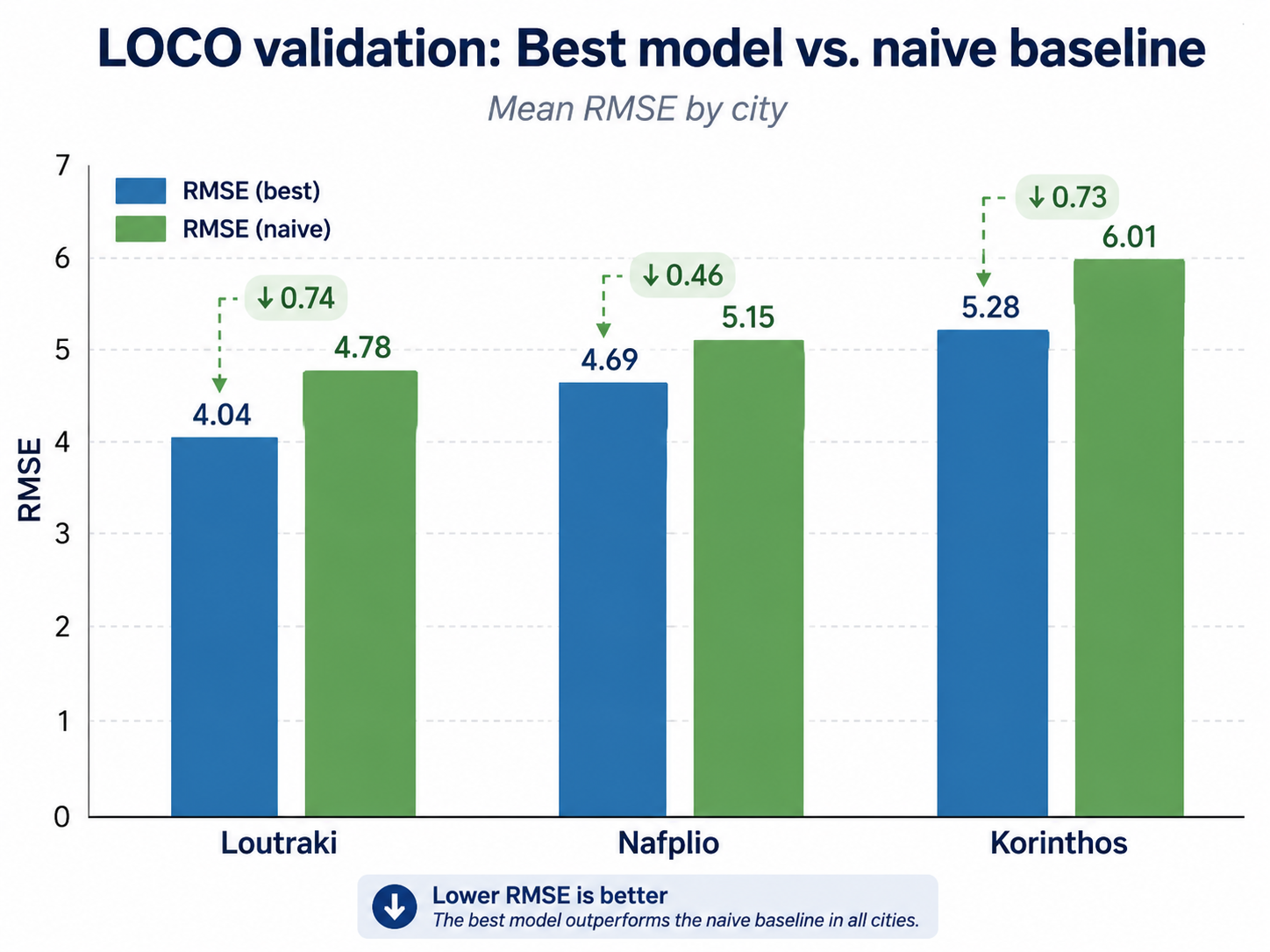 Validation results showing improved next-day 5G signal strength prediction compared with
a naïve baseline across three urban measurement areas.
Validation results showing improved next-day 5G signal strength prediction compared with
a naïve baseline across three urban measurement areas.
Key insights
Two findings are particularly important for INTERPLAY.
- Improved accuracy: the proposed machine learning models consistently improved prediction accuracy compared with a simple persistence baseline, including in leave-one-city-out validation across all three cities.
- The power of time: the analysis showed that short-term temporal dynamics, such as recent signal history and rolling averages, are the dominant predictors of 5G signal variation, and are more informative than static geographic or tower-related descriptors.
This supports INTERPLAY’s long-term direction towards adaptive and self-optimizing systems, where communication choices can be informed by anticipated network conditions rather than only by real-time measurements.
Research highlight: Where and when 5G links can support critical services
Smart-city resilience requires a multifaceted understanding of connectivity beyond simple availability. INTERPLAY bridges this gap by evaluating where and when 5G can meet specific service requirements for monitoring or emergency response.
This framework integrates real-world field measurements to estimate link reliability via RSRP/SINR indicators with site-specific ray tracing to model how urban geometry affects performance. Together, these methods enable service-aware decision-making based on both empirical data and environmental modeling.
Data-driven 5G link reliability from field measurements
INTERPLAY research utilized real-world 5G field measurements to estimate link reliability from standard network indicators such as RSRP and SINR. This allows us to move beyond basic coverage assessment and interpret 5G performance in terms of service needs.
What this enables:
- Service-aware reliability: linking radio measurements to URLLC, eMBB and mMTC requirements.
- More useful coverage insight: distinguishing signal availability from robust service support.
- Better decision-making: supporting future adaptive communication choices within the INTERPLAY framework.
Site-specific urban propagation and service-level performance
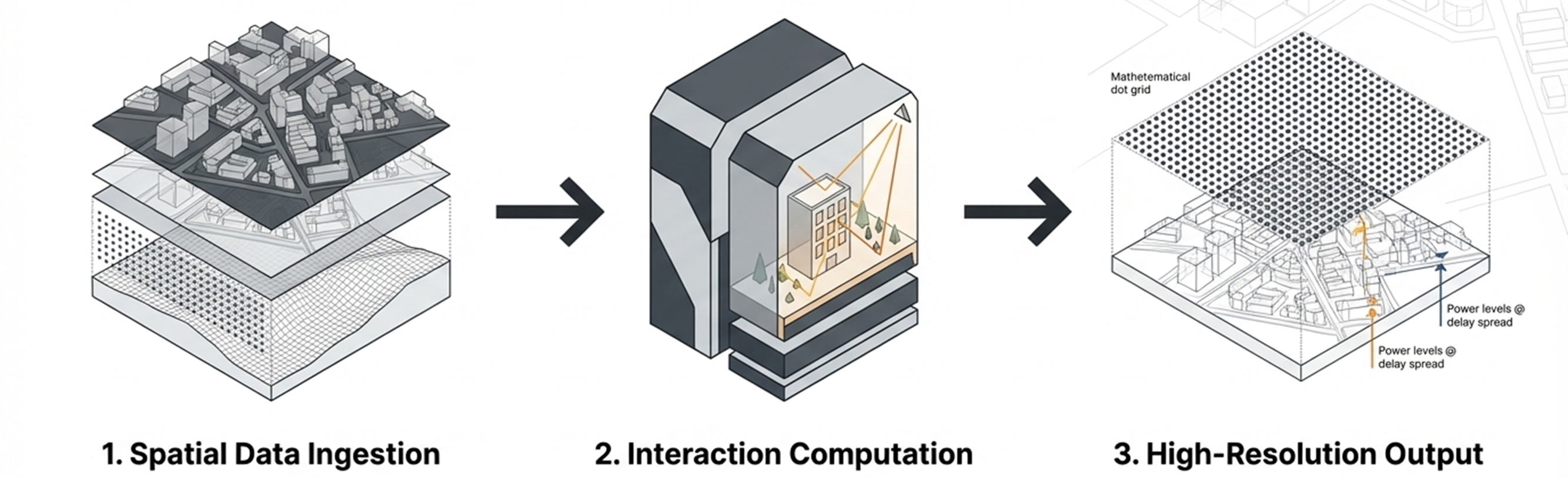 Ray-tracing workflow used to assess how urban geometry affects 5G propagation and
service-level performance.
Ray-tracing workflow used to assess how urban geometry affects 5G propagation and
service-level performance.
INTERPLAY also uses deterministic ray tracing propagation modelling to understand how real urban geometry affects 5G pathloss and delay spread. This helps assess whether different city environments can support demanding services, especially low-latency and high-reliability applications.
What this enables:
- Real-world system planning: linking urban geometry, frequency and signal behaviour.
- Service-level insight: assessing eMBB, mMTC and URLLC under realistic conditions.
- Better risk understanding: showing where URLLC is especially sensitive to delay dispersion, not only to signal strength.
Looking ahead
Upcoming work will focus on continued system integration, testing scenarios and use-case alignment, preparing the project for broader system-level validation.
Stay Connected
Follow the INTERPLAY project on LinkedIn
👉
https://www.linkedin.com/company/interplay-project-eu
Dissemination note
The research results highlighted in this update have also supported recent scientific conference presentations by the INTERPLAY team, including two at EuCAP 2026 and three at PACET 2026, contributing to the project’s dissemination activities.